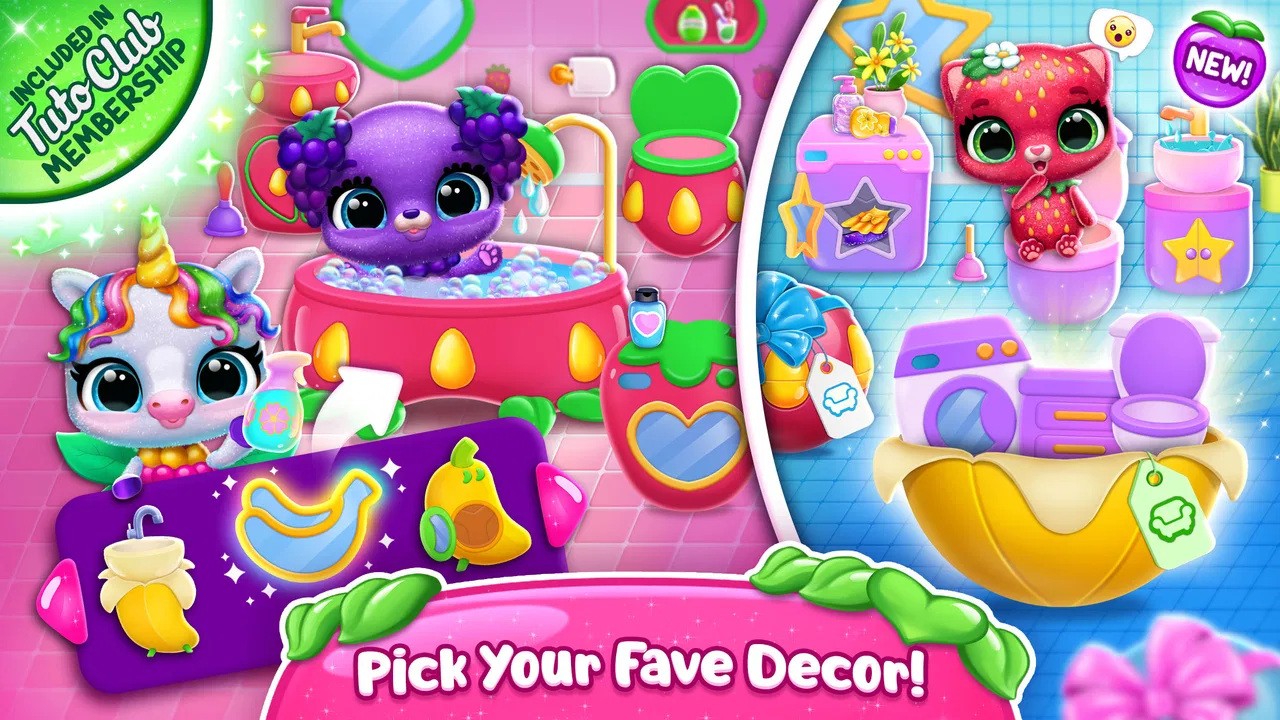
Fruitsies - Pet Friends
- 4.0
- Rating
- 10.00M
- Installs
- Free
- Price

 Analysis by App-foxy
Fruitsies - Pet Friends is the kind of educational game I would hand to a child who enjoys caring for cute animals but is not ready for a complicated simulation. The basic appeal is easy to understand: hatch eggs, meet virtual pets, and spend time with them through simple play. I found the experience approachable rather than demanding, which makes it a comfortable choice for short sessions on a family phone or tablet.
What makes it worth discussing beyond its cheerful presentation is the way it combines pet-care imagination with light, repeatable activities. This is not an app I would choose for deep lessons, challenging strategy, or competitive play. I see it more as a gentle digital playroom where children can explore routines, make choices, and enjoy the satisfaction of looking after virtual creatures. That distinction matters, especially when parents are deciding whether a free game will remain pleasant after the first few minutes.
How the pet world feels in everyday use
I approached Fruitsies as a game for small bursts of attention rather than a title designed for long, uninterrupted sessions. A child can open it, focus on a pet, play for a while, and leave without needing to remember a complicated story or a large set of rules. That makes it useful during a quiet break, while waiting for an appointment, or when a parent wants a calmer alternative to an action-heavy game.
You May Also Like

 Blood Strike: 2.5 Anniversary
Blood Strike’s Loadouts Turn Every Drop Into a Tactical Gamble
A close look at Blood Strike’s custom loadouts: how fast access to signature weapons reshapes its battle royale rhythm, rewards preparation, and narrows the gap between fights.

 Pandora - Music & Podcasts
Pandora’s Music Is Easy to Start, but Harder to Recover
Pandora’s strength is its low-effort path from a seed to a station. Its weak spot is how much confidence it asks you to place in connection, setup, and quiet recovery.

 8 Ball Pool
 Is Built on Rivalries, Rematches, and Routine
A close look at the rivalries, rematches, shared routines, and unanswered safety questions that turn a quick pool match into a persistent mobile community.

 Samsung Music
’s Quiet Strength Is Playing What You Already Own
Its reach comes less from spectacle than from dependable access to a personal library. That simplicity is both the app’s strongest retention engine and its ceiling.

 AccuWeather: Weather Radar
AccuWeather Review: A Quick, Clear Forecast for Everyday Decisions
For everyday plans, the best forecast is the one you can understand quickly. AccuWeather makes rain timing, radar, and local conditions easy to act on, with a few trade-offs.

 Hill Climb Racing
Why Hill Climb Racing Still Turns Crashes Into One More Run
A tiny car, a bumpy hill and one more upgrade: Hill Climb Racing keeps resurfacing because its simple chaos makes every near-miss feel personal.
More From Our News Desk



The central loop is deliberately friendly. Eggs give the experience a sense of anticipation, while the virtual animals provide a reason to return and interact. For a young player, that combination can be more motivating than a conventional educational quiz because the reward is connected to a character they feel attached to. I would describe the learning value as informal: children practice attention, sequencing, and simple responsibility through play, rather than studying a defined school subject.
The game comes from TutoTOONS, a developer known here for a child-focused style. Its classification as an educational game is reasonable in the broad sense, though I would not confuse that label with a structured learning course. Parents looking for spelling, mathematics, reading practice, or measurable curriculum progress should use a dedicated learning app instead. Fruitsies works better as playful enrichment, particularly for children who respond to animals and gentle pretend-care activities.
One practical strength is the low barrier to entry. The game is free to download, carries an Everyone age rating, and supports devices running Android 7.0 or later. That combination makes it accessible to many families with older phones or tablets. The current version is 1.9.502, so I would still check that a child’s device can run it comfortably before planning to use it regularly, especially if the hardware is several years old.
The audience size also suggests that this is not an obscure experiment. Fruitsies has passed ten million installs and holds a 4.0 average from around fourteen thousand ratings. I do not treat popularity as proof that every family will enjoy it, but it does indicate that the basic concept has reached a substantial number of players. The more useful question is whether the style matches the child: if they like collecting, nurturing, and cute characters, the fit is much stronger than it would be for someone who wants puzzles or fast competition.
A realistic family scenario
Imagine a child using a shared tablet after school while a parent prepares dinner. The child can choose to spend a few minutes with a pet instead of starting a large adventure that demands constant supervision or a long time commitment. A parent can also sit nearby and use the animal interactions as a starting point for conversation: What does the pet need? Which activity should come next? Why is it useful to finish one small task before moving to another?
That kind of shared use is where I think the game has more value than its simple appearance suggests. It can become a prompt for talking about routines and choices, even though the app itself is not a parenting tool. I would not leave a very young child alone with any free-to-play game for unlimited time, but short, visible sessions make this one easier to fit into a family routine than a more intense title.
What to watch during progress
The egg-and-pet structure naturally creates a feeling of progress, but it can also create pressure to keep returning. Children may want to see what comes next, collect another animal, or continue a care routine after they have already had enough screen time. I recommend setting the session limit before opening the game rather than negotiating at the moment a child is eager to continue.
A useful approach is to make the game part of a predictable sequence: finish a small real-world task, play for an agreed period, then put the device away. This keeps the virtual pet from becoming the only source of motivation. It also helps children understand that progress in the game is optional, not an obligation. I found that framing especially important for younger players who can interpret a waiting period or locked item as something they must solve immediately.
Another practical tip is to let the child explain what they are doing instead of taking over. Asking them to describe why they chose a particular pet activity turns passive tapping into a small exercise in planning and communication. It also reveals whether they understand the game or are simply pressing whatever looks bright and inviting. That is a more useful measure of the educational benefit than the presence of an educational category label.
Free access and spending boundaries
Fruitsies is free, but it includes in-app purchases ranging from $1.49 to $159.99 per item. That is the most important fact for parents to understand before handing over a device. The presence of a very high maximum purchase means I would not rely on a child’s judgment alone, even if the child only intends to obtain a small item. Device-level purchase protection and a clear family rule are sensible safeguards.
I also would not describe the game as automatically unfair simply because it sells optional items. The purchase information confirms the range, but it does not by itself explain exactly how every item affects play, how frequently purchase prompts appear, or whether a child can reach all meaningful activities without spending. I prefer to separate what is known from what is not: families can prepare for spending risk, but they should avoid assuming that every part of progress is either blocked or completely unaffected by purchases.
For a child, the difference between “free to play” and “free of pressure” can be significant. If the game presents a desirable pet or object at the moment enthusiasm is highest, the child may feel that buying is part of caring for the virtual world. I would therefore keep purchases under adult control and explain that digital items are optional extras, not necessities. This conversation is valuable even when no money is spent.
My own fairness test is simple: can the child enjoy a short session without feeling that the game is constantly asking for money? If the answer becomes no in practice, I would remove it from the regular rotation, regardless of how cute the pets are. A free title should fit the family’s boundaries, not force the family to redesign them.
Where it sits beside other children’s games
Compared with a dedicated educational app, Fruitsies is less precise. A mathematics app can tell a parent which skills are being practiced; a reading app can offer clearer progression; a language game can be chosen around a specific learning goal. Fruitsies does not replace those options. Its advantage is emotional accessibility: a child who resists worksheets may be more willing to engage with an animal-centered activity.
Compared with a traditional virtual-pet game, the educational positioning gives it a softer purpose, but I would still judge it mainly as playful pet care. It is not the right alternative for children who want open-ended building, competitive leaderboards, complex puzzles, or a large narrative world. Those games may offer more depth, while Fruitsies is easier to understand and less intimidating at the beginning.
It also differs from fast arcade games because the appeal is not reflex speed. That can be a positive for children who become frustrated by failure or overstimulation. On the other hand, players who need constant novelty may lose interest once the initial excitement of hatching and meeting pets fades. I would choose it for a child who enjoys repetition with a comforting theme, not for one who asks for a new challenge every few minutes.
Questions I would settle before installing
Will it work on an older family device? The minimum operating-system requirement is Android 7.0, so compatibility is broader than with many newer games, although the actual experience can still depend on the device. I would install it ahead of time, check that it opens smoothly, and make sure the screen and sound are comfortable before giving it to a child.
Is it suitable for a very young player? The Everyone rating makes it broadly age-appropriate, but age labels do not replace supervision. The child’s reading ability, patience, and understanding of purchases matter more than the label alone. A preschooler may enjoy the animals while still needing an adult to handle menus and explain when the session ends.
Does it teach a specific subject? Not in the way a focused school-support app does. I would present it as a game that encourages gentle interaction, choice-making, and pretend responsibility. If the family’s goal is measurable academic practice, I would spend the available screen time elsewhere and use this as an occasional recreational option.
Can it be played without spending? The game is free, and purchases are optional in the sense that they are separate paid items, but the listed range means I would establish controls before play. I would also observe the child’s reaction to any locked or tempting content rather than assuming the experience will feel equally comfortable for every player.
Will it remain interesting? That depends heavily on the child. The pet theme gives it a clear identity, but children who prefer construction, stories, or competitive challenges may find it limited. I would treat the first session as a trial, paying attention to whether the child is engaged by caring for the animals or merely excited by the first discovery.
My trust verdict for families
I came away seeing Fruitsies - Pet Friends as a pleasant, accessible choice for children who like virtual animals and uncomplicated play. Its strongest use is not academic instruction but gentle engagement: a child can interact with pets, follow a simple rhythm, and enjoy a world that feels less intense than many mainstream mobile games. The free entry and Everyone rating make it easy to consider, while the Android requirement keeps it viable for a range of older devices.
My reservation is spending pressure. Because individual in-app purchases can reach $159.99, I would never treat the game as something a child should explore with unrestricted payment access. I would also monitor whether the desire to hatch or collect pets starts extending screen time or creating arguments. Those are not reasons to reject the game automatically; they are reasons to use it with clear boundaries.
The rating of 4.0 from around fourteen thousand ratings gives it a respectable public reception, but it does not tell me whether it will suit a particular child. I would recommend it to families seeking a cute, low-complexity pet game with an educational flavor, especially when the goal is a short shared activity. I would skip it for children who need structured lessons, dislike repetitive care loops, or become easily upset by optional purchases and the possibility of wanting more content.
My final recommendation is cautious but positive: try it as a supervised, time-limited play experience, not as a substitute for learning software or an unlimited babysitter. With purchase controls in place and realistic expectations about its purpose, Fruitsies can be a friendly way for a child to spend a little time with virtual pets. Its charm is genuine, but the best results come when adults decide the boundaries before the game becomes part of the daily routine.
FAQs for Fruitsies - Pet Friends
01What is Fruitsies - Pet Friends, and what can you do in the game?
Fruitsies - Pet Friends is a casual virtual-pet game where you care for colorful animal characters, feed them, play mini-games, and help them grow in a cheerful world. During my time with the app, its main appeal was the simple routine of looking after pets while decorating spaces and unlocking additional content. It is designed primarily for children and families, with easy controls and bright, friendly presentation.
02Is Fruitsies - Pet Friends suitable for children?
The game is generally aimed at young children because the activities are straightforward, the visuals are colorful, and the interactions are nonviolent. Children can enjoy feeding, bathing, entertaining, and caring for the pets without needing advanced gaming skills. However, parents should still review the available settings, advertisements, and purchase options before handing over the device, especially if the child will play without supervision.
03Does Fruitsies - Pet Friends require an internet connection?
Many of the basic pet-care activities may be available without a constant connection, which makes the game convenient for short offline play sessions. Nevertheless, internet access can be needed for advertisements, updates, restoring purchases, or accessing certain online features. Availability may also differ depending on the device and version installed, so it is best to test the game after downloading it if offline access is important.
04Are there in-app purchases or advertisements in Fruitsies - Pet Friends?
Fruitsies - Pet Friends may include advertising and optional in-app purchases, as is common with free-to-download children’s games. These can relate to removing ads, unlocking items, or accessing additional content. The core experience can be explored without immediately buying anything, but parents should check the store listing and enable purchase restrictions where appropriate. This helps prevent accidental transactions during unsupervised play.
05Does Fruitsies - Pet Friends offer enough content to remain enjoyable over time?
The game is best suited to players who enjoy relaxed, repetitive virtual-pet activities rather than complex missions or competitive gameplay. Caring for different pets, completing small activities, collecting items, and customizing the environment can provide ongoing entertainment, particularly for younger users. However, experienced gamers may find the progression simple after extended play. Its lasting appeal depends largely on how much the player enjoys nurturing and personalization.
Pros
- Bright
- child-friendly visuals make the pets appealing and easy to recognize.
- Simple touch controls are accessible for younger players.
- Pet-care activities encourage gentle routines and responsibility.
- Short activities work well for quick play sessions.
- The colorful world is inviting for children who enjoy virtual pets.
Cons
- Some activities may feel repetitive after extended play.
- Younger children may need help navigating menus and settings.
- Progress can feel slow without frequent play sessions.
- The game may require substantial storage on older devices.
- Parents should check in-app purchase and advertising settings before play.

Fruitsies - Pet Friends
Gallery